
Good Child
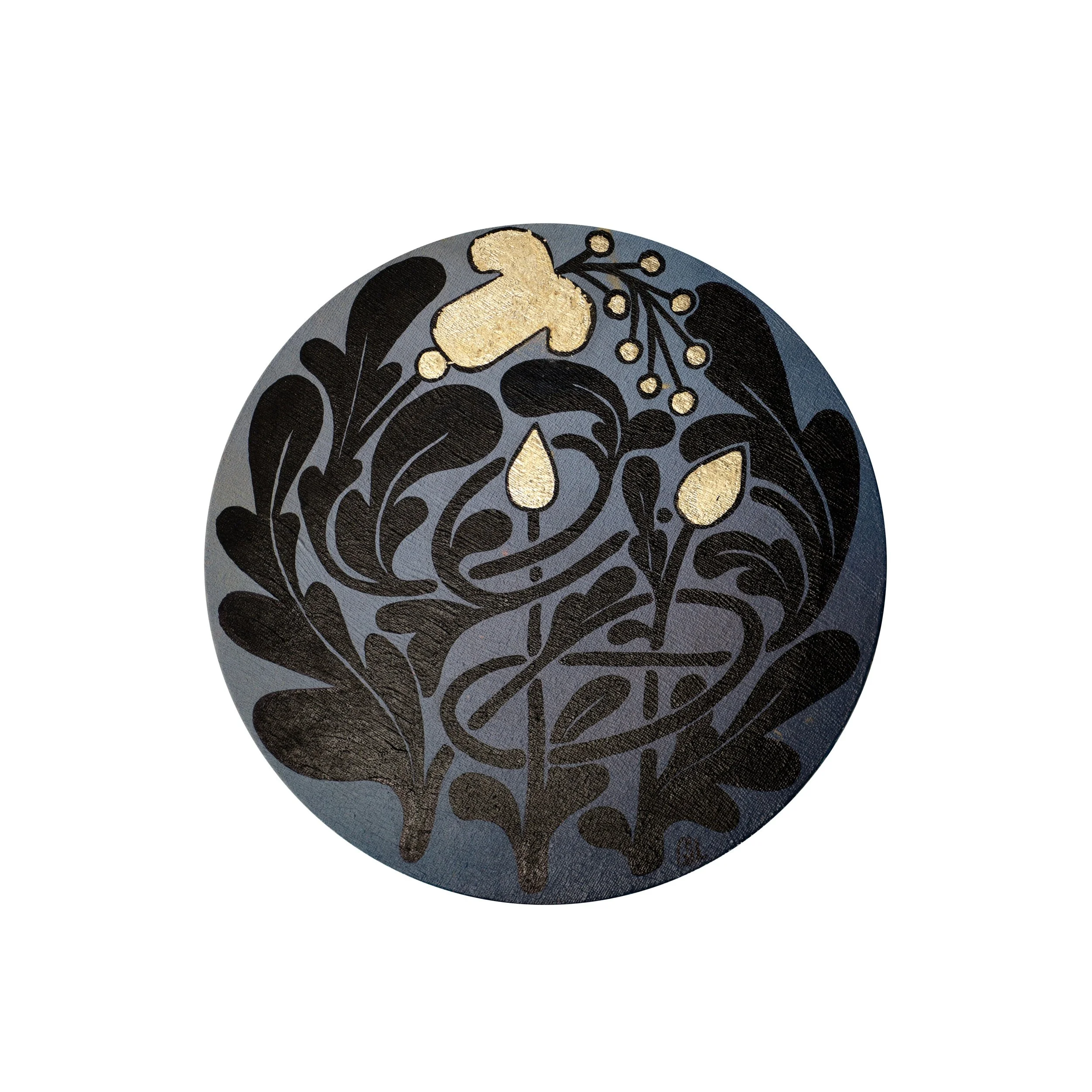
2024
Ink, spray paint, gold leaf on cotton
30 cm
Author's Note
There was a phrase my grandmother used whenever I behaved myself at the table, sat quietly during long visits, or carried out the endless gardening chores. "A good child." It wasn't tender, exactly. It was almost transactional, an acknowledgment of meeting a standard rather than a gesture of pride. I used to chase that phrase, sometimes for weeks at a time, performing a version of myself that was easier to live with.
Years later I understand it differently. The "good child" is also the one who learns early to fold themselves into smaller shapes to be loved. I painted this with both things in mind. The plant that is upright and obedient, does not necessarily flower. The gold marks the parts that were able tu surpass the deep-etched need to glow only when watched.

Description
"A Good Child" is a circular composition painted on a stretched cotton canvas, presenting a trio of stylised plants on a dark gradient background. A single botanical form rises from a knotted base of intertwined stems, with deeply lobed leaves curving outward in near-symmetry. Three buds occupy the central axis. Two of them are touched with gold leaf, while the uppermost flower opens into a soft asymmetry that breaks the otherwise mirrored structure. The black silhouette borrows the visual grammar of Kociewian wycinanki and pre-war devotional iconography, while the tondo format lends the piece an almost reliquary quality.
Technical Information
The work is executed on a cotton canvas stretched on a circular frame, prepared with several layers of gesso to retain the subtle grain of the support beneath the paint. The figure is laid in black oil with a flat, almost graphic finish, while the ground was built up in thin atmospheric washes of grey and indigo to create a slow shift of tone from the centre outward. Warm-hue gold leaf is applied to buds’ insides and one flower, gilded directly onto a thin oil size so the metal sits flush with the surface rather than floating above it. The contrast between the matte black plant and the reflective gold passages produces a viewing experience that changes throughout the day, depending on light.
Conceptual Framework
"A Good Child" explores the quiet cost of being shaped to please. The plant is composed and well-mannered, its forms ordered along a vertical spine, its leaves balanced, its growth tidy. The gold reads, at first, as ornament. On closer reading, it marks the points that have been singled out for the approval of others: mostly unopened buds, with only few that flower. The tondo recalls family portraits, devotional medallions, and the round mirrors that hang in old Pomeranian homes. By placing a folk-coded plant inside that frame, the work asks what we inherit when we inherit a standard of behaviour, and what part of a child has to be quieted for the household to remain calm.