
Context of the Work
Where this comes from?
The patterns that inspire my paintings
are not newly-invented.
They come from embroidery guide plates. Hand-drawn templates that Kociewian women passed between families for generations. My great-grandmother used them. Her mother before her. The plates weren't signed or dated. They were working documents, not art. They told you where to put the needle.
I grew up with these patterns on tablecloths,
on curtains, on pillowcases.
I didn't think of them as heritage or tradition. They were just the surface of my grandparents' house. It took leaving; studying law, working in marketing and burning out before I understood what I'd been looking at all those years.
When I came back to painting, the patterns came back with me. Not as copies. As a starting point.
What I'm actually doing?
I take Kociewian folk embroidery patterns and rebuild them as paintings.
The symmetry and floral vocabulary stay. But the technique changes completely. Colourful paints, mixed media, gold leaf on heavy Belgian linen. The result doesn't look like embroidery. It looks like something caught between embroidery and abstract painting, which is exactly where I want it to sit.
The compositions are symmetrical because the source material is.
Embroidery patterns mirror along a central axis because that's how you stitch efficiently. I keep that structure because it creates a tension with the painterly marks.
While the geometry says control. Not quite, mine brushwork argues. That tension is what the work is about.
The textures are heavy.
The colours, sometimes anxious.
The lines knot and tangle in ways the original embroidery never would. If the source material is my grandmother's kitchen table, the paintings are what that table looks like filtered through a decade of corporate burnout and the particular restlessness of trying to figure out what you actually want to make.
I've started calling this post-folk. It's my term, not an established category.
It describes the space between reverence for the source material and a refusal to leave it where I found it.
The tradition behind it
Kociewie is a small ethnocultural region in northern Poland, south of Gdańsk, along the western bank of the Vistula River. Its folk traditions: embroidery, paper cutting, woodcarving All developed in relative isolation and remained a living practice well into the twentieth century.
The embroidery in particular is characterised by dense, interlocking floral motifs, strong bilateral symmetry, and a limited palette that varied by village.
Unlike the better-known folk traditions of Łowicz or Kurpie, Kociewian decorative arts received relatively little academic attention and were never significantly commercialised for tourism. This means the patterns I work from haven't been flattened into souvenirs. They still carry the specific, local, idiosyncratic character of the communities that made them.
This matters to me because I'm not working with "Polish folk art" in some general sense. I'm working with familiar patterns, from one region, passed down through one small group of women. The specificity is the point.
Influences I'll own
The Polish interwar avant-garde is a real influence. Particularly the Formists (1917–1922), who were trying to build a modern Polish visual language out of folk sources rather than importing one from Paris. They didn't fully succeed, but the ambition is relevant. I'm asking a version of the same question they were: what does it look like to be rooted in a specific tradition and contemporary at the same time?
Kenneth Frampton's writing on Critical Regionalism in architecture, like the idea that you can resist both generic globalisation and reactionary nostalgia by working seriously with local materials and traditions, has shaped how I think about what I'm doing. I'm not preserving Kociewian embroidery. I'm not abandoning it either. I'm using it as a source material.
Beyond that, I learn from looking. I pay attention to artists working with heritage in ways that avoid both sentimentality and ironic distance. There are many. I'd rather not list them, because comparisons imply equivalence, and I'm early in this.
What I can say is that the conversation between traditional craft and contemporary painting is happening in many places right now, and I'm part of that conversation. With a view from a very specific corner of northern Poland.
Technical notes for curators
Medium and support
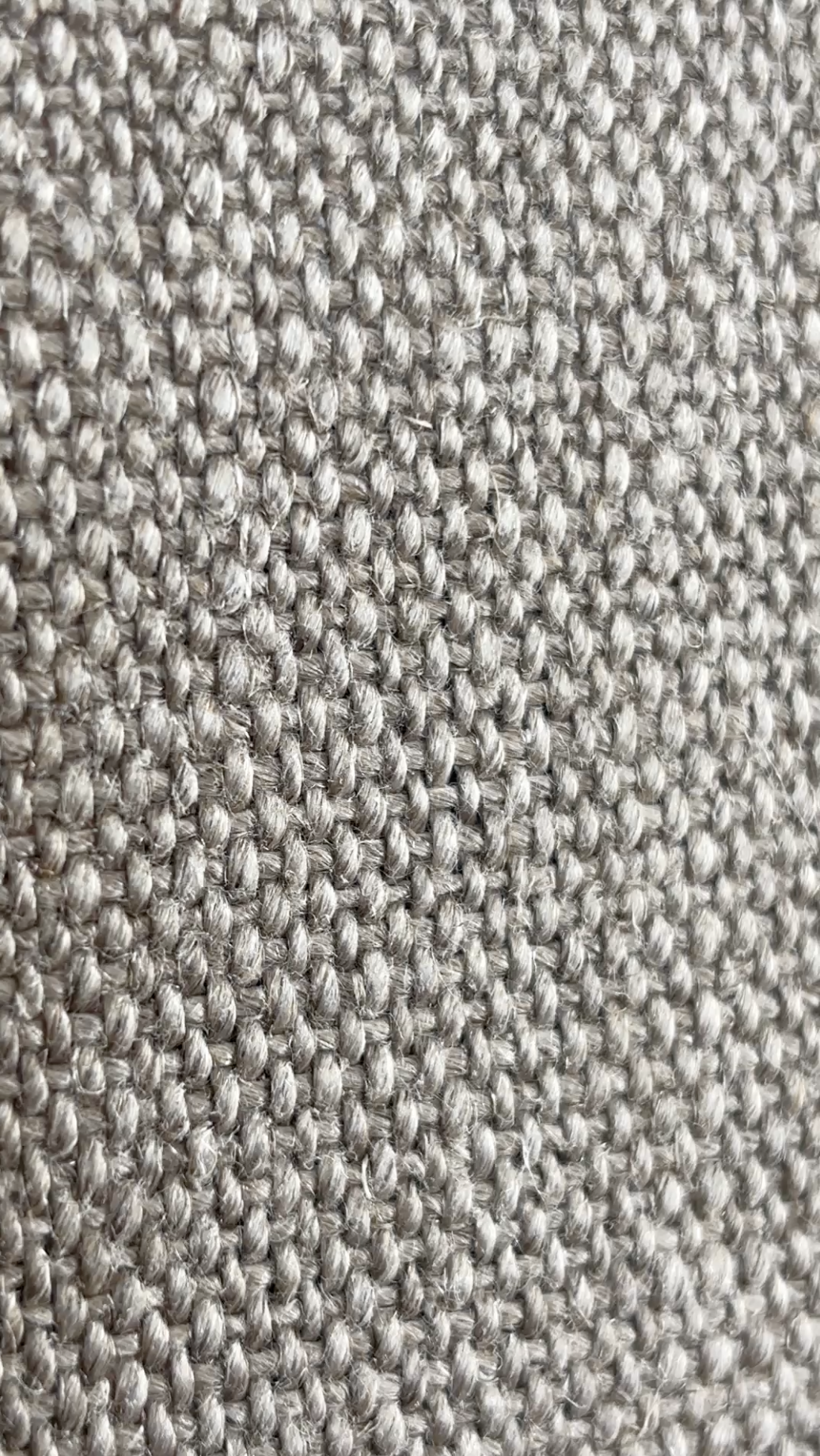
Most paintings are executed in oil on Belgian linen, which I source, stretch, and prime myself.
The heavy linen is a deliberate choice, as its texture and absorbency produce a surface quality that thinner cotton or synthetic canvas can't replicate. Some works incorporate mixed media: gold leaf, traditional pigments sourced regionally, ink, and spray paint.
Process
I work from drawn compositions that reference the original embroidery guide plates, but the translation from drawing to painting is where the work happens. Layers are built up and scraped back. Lines that look controlled from a distance reveal reworking and hesitation up close. The tension between the geometric source and the gestural execution is maintained deliberately and I don't resolve it.
Scale
Works range from 18 × 24 cm studies to 100 × 80 cm paintings.
Larger scales are available on commission.
Provenance and documentation
All original paintings ship with a certificate of authenticity and are recorded in the studio's ledger (buyer, date, price, condition at sale). Works above €3,000 are available by enquiry.
For institutions
If you're preparing an exhibition text, catalogue essay, or acquisition proposal, I'm happy to provide high-resolution images, detailed condition reports, and whatever background material is useful.
I can also provide the original embroidery guide plates that inform specific works, for context.
For press, exhibition loans, or institutional acquisitions: studio@petergil.com
I respond personally, usually within two-three working days.